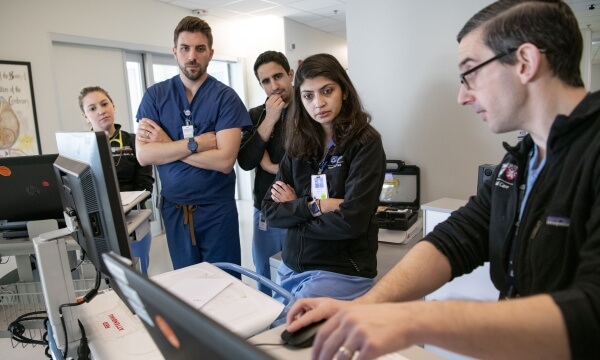
Neurocritical Care
The Neurocritical Care fellowship is a two-year UCNS-accredited program for general and neurologic critical care training.
A Month at a Glance
Eric S. Rosenthal, MD
Message from the Director
Welcome to the Massachusetts General Hospital, Brigham and Women's Hospital, and Harvard Medical School Fellowship Training Program in Neurocritical Care.
We are proud to be not only the country’s oldest neurocritical care training program, but also one of its most innovative. The outstanding care, clinical and research innovations, and clinical and research leadership provided and generated by our graduates have played a significant role in the transformation of acute and preventative care for patients across the world. To support this educational mission, we have built a program that stretches beyond the walls of the ICU, encompassing training in telemedicine, airway management, bedside emergency ultrasound, transcranial ultrasonography, general critical care, EEG and electrophysiology, bronchoscopy, formal simulation training, international health, guideline and protocol development for clinical practice innovation, and a major component of independent elective time for reinforcing these diverse clinical skills or for mentored academic research in a wide variety of settings.
A unique aspect of our program is the strong individualized mentorship provided to each trainee. I devote substantial effort to the career development of our fellows, recognizing that each of you comes to us with different backgrounds, different strengths and different goals. I work with fellows individually, getting to know them and helping each one of them to identify a uniquely tailored career direction that will lead to substantial professional contributions as well as personal satisfaction. We welcome applicants with a variety of long-term goals, including future clinicians who may be a clinical leader of an intensive care unit, a champion of clinical innovation, an independent federally-funded investigator, or a leader spreading the international mission of neurocritical care federally-funded research. We nonetheless believe that learning and applying a scientifically-based rigorous approach to data analysis, at the bedside and in research, is the foundation for providing outstanding care to the patients of today and improving the care of patients of tomorrow.
Our clinical fellows interact with a variety of faculty, fellows from colleague training programs, as well as a large group of research fellows who join our community to pursue and support cutting-edge clinical research.
We invite you to visit us and help us innovate by joining our team.
What Our Fellowship Offers Prospective Trainees
- Broad and Deep Clinical Training through a core clinical experience in neurocritical care in the Neuro-ICU and additional clinical training in general critical care within the Surgical, Medical, and Cardiac Intensive Care Units.
- Leadership Training via fellow-driven design of Patient Management Guidelines and Protocols.
- Formal Didactic Procedural Training with an established didactic training series encompassing general ultrasound, bronchoscopy, airway management, Transcranial Doppler ultrasound, EEG, and opportunity to build these skills in a dedicated clinical environment.
- Formal clinical experiences for airway management training in an operative environment.
Simulation training for code management, airway skills. - Diverse research experiences in clinical, patient-oriented, informatics, computational, and laboratory-based research, with a broad and deep list of available mentors.
- Dedicated Flexible Elective Time.
- Multiple Didactic Lecture Series including Neuro-ICU Leadership (Monday), Acute Stroke and Vascular Neurology (Wednesday), General Criticial Care (bimonthly on Thursday), and Neurocritical Care Practice (Friday).
Hospitals & Leadership
Fellows in this program will train at the Massachusetts General Hospital and Brigham and Women’s Hospital and will have access to additional training at Spaulding Rehabilitation Hospitals. Fellows will have significant interaction and collaboration with physicians, nurse practicioners, clinical nurse specialist, therapists, nutritionists, specializing in neurology, epilepsy and neurophysiology, neurosurgery, other critical care disciplines, radiology, neuro-interventionalists, and rehabilitation medicine.
|
|
||
| Neurosciences Critical Care, Lunder building, Massachusetts General |
Spaulding Rehabilitation Hospital | Brigham and Women's Hospital |
Faculty, Massachusetts General Hospital
Neurocritical Care and Acute Stroke
- Christopher Anderson, MD - Attending Physician
- Leigh R. Hochberg, MD, PhD, Associate Neurologist, Attending Physician
- W. Taylor Kimberly, MD, PhD, Associate Director, Neuroscience Intensive Care Unit
- Thabele Leslie-Mazwi, MD, Attending Physician
- Guy Rordorf, MD, Attending Physician
- Jonathan Rosand, MD, Director, Neuroscience Intensive Care Unit & Emergency Neurology
- Eric S. Rosenthal, MD, Associate Director, Neuroscience Intensive Care Unit, Program Director, Neurocritical Care Fellowship
- Lee H. Schwamm, MD, Director, Telestroke and Acute Stroke Services
Neurocritical Care and Neuroanesthesia
- Ala Nozari, MD, PhD, Attending Physician
Vascular Neurology and Acute Stroke
- Ferdinando Buonanno, MD, Attending Physician
- Natalia S. Rost, MD, Physician
- Scott B. Silverman, MD, Physician. Program Director, Vascular Neurology Fellowship
- Aneesh B. Singhal, MD, Director, Neurology Quality and Safety
- Anand Viswanathan, MD, Physician
Faculty, Brigham and Women's Hospital

Faculty, Brigham and Women's Hospital
Neurocritical Care and Acute Stroke
- Sherry Chou, MD, Physician
- Steven K. Feske, MD, Physician, Site Director, Neurocritical Care Fellowship
- Galen V. Henderson, MD, Director of Critical Care and Emergency Neurology
- Leigh R. Hochberg, MD, PhD, Associate Neurologist, Attending Physician
- Allan H. Ropper, MD, Executive Vice Chair, Neurology
- Farzeneh Sorond, MD, Physician
Neurosurgery and Acute Stroke
- William Gormley, MD, MPH, Physician
Our Current Fellows
- Torrey Boland, MD
- Brian Edlow, MD
- Ruchira Jha, MD
- Ariane Lewis, MD
- Bradley Molyneaux, MD, PhD
- Patricia Musolino, MD
- Casey Olm-Shipman, MD
- Nils Petersen, MD
- Kiran Poudel, MD
- Chia Ling Phuah, MD
- Henrikas Vaitkevicius, MD
Alumni - 2005 to Present
- Christopher D. Anderson, MD
- James Bartscher, MD
- Katharina Busl, MD
- Raphael Carandang, MD
- Sherry Chou, MD
- Corey R. Fehnel, MD
- David Y. Hwang, MD
- Sayona John, MD
- W. Taylor Kimberly, MD, PhD
- Monisha Kumar, MD
- Terrance T. Kummer, MD
- Julius Gene Latore
- Kiwon Lee, MD
- Wolfgang Leesch, MD
- Thabele (Bay) Leslie-Mazwi, MD
- Joshua Levine, MD
- Matthew Maas, MD
- Brijesh P. Mehta, MD
- Susanne Muehlschlegel, MD
- Soojin Park, MD
- Nicholas (Steve) Potter, MD, PhD
- Celine Rahman, MD
- Pankajavalli Ramakrishnan, MD, PhD
- Varun Reddy, MD
- Eric S. Rosenthal, MD
- Kevin Sheth, MD
- Bradford Thompson, MD
Tommy Thomas, MD
Updated 8/10/12, 11/20, 12/7/12

Applicants must have a strong academic record of training in Neurology.
From left to right, Mary Guanci, RN, nurse clinical specialist; Jonathan Rosand, MD, Director, Neurocritical Care & Emergency Neurology, and Terrance Kummer, MD, Neurocritical Care Fellowship alumni
Updated 8/10/12, 11/20, 12/7/12
Neurocritical Care Fellowship Training Program Curriculum

Neurosciences ICU Staff

A patient's room in the Neurocritical
Care Facility in Mass General
Neurosciences ICU
Mission and Goals
- Broad and deep clinical training inside and outside the neurocritical care environment
- Increased independence with advancement in training
- Diverse research experiences
- Leadership training via fellow-driven design of patient management guidelines and protocols
- Comprehensive didactic and hands-on procedural training
Clinical Rotations
Neurocritical Care
- MGH Neuro ICU, Red Team (encompassing Critical Care Neurology and Neurotrauma)
- MGH Neuro ICU, Blue Team (encompassing Neurovascular Critical Care and Perioperative Critical Care)
- BWH Neuro ICU, Critical Care Neurology and Acute Stroke Service
- BWH Neuro ICU, Critical Care Neurosurgery
- MGH Neuro ICU night float coverage
Acute Stroke Neurology
- MGH Acute Stroke and TeleStroke Team Leader
Structured Elective Experiences
- Neuroanesthesia and Airway Management (mandatory)
- EEG and Neurophysiology
- General Ultrasound
- Internventional Pulmonary Training
- Affiliated Intensive Care Unit Training: Surgical Intensive Care Unit (SICU), Medical Intensive Care Unit (MICU), and Cardiac Care Unit (CCU)
- Transcranial Doppler Ultrasound
Independent Elective Time
- Independent, Research with Faculty Mentorship
- Additional Selective Experience Rotations
- International Neurology Elective
Weekly Conferences
Weekly Conference with teleconferencing available as needed.
- MGH NeuroICU Conference (Monday 4pm) - Go to Calendar
- Fellow Didactic Conference (Thurs. 2:00 pm, 1st and 3rd each month)
- Critical Care Center Multidisciplinary Didactic Conference (Thurs. 2:00 pm, 2nd and 4th each month)
- Brigham & Women’s Stroke/ICU Conference (Friday 1:30-2:30 pm)
Formal Procedural Training
- Longitudinal general ultrasound training hands-on workshops and didactics
- Formal arterial and venous access training
- Simulation training for code management, airway skills
- Hands-on workshops and didactics in emergency airway management
Calendar
Updated 8/10/12, 11/20, 12/7/12
Clinical Facilities

A patient's room in the Neurocritical
Care Facility in Mass General
Neurosciences ICU

Quantitative EEG and
Integrated Neuromonitoring

Portable CT

IA Team
The MGH Lunder Neuro-ICU (www.mghneuroicu.org) opened for patient care in September 2011. The Neurosciences ICU occupies the entire 6th floor of the Lunder Building. Stepping off the elevator, into the Neuro ICU Atrium, the building’s centerpiece is calming and inspiring. The building was designed and constructed using green features and strategies for energy conservation, water efficiency, carbon dioxide emission reductions and sustainable resources to provide the utmost care for our patients and provide a natural environment that can help promote healing. The Atrium has floor-to-ceiling glass walls, and a dozen hanging plants that filter in natural light. Allowing city and river views, bamboo-rimmed patient room line the perimeter of the sixth floor. Clinically, the expansion allowed for a neuromonitoring suite, intended for EEG readings, MRI’s, and CT scans in-house to ensure timely diagnosis and treatment, and less travel for the ICU patients. Along with the expansion of space, all of our inpatient rooms offer specialized features such as ceiling mounted equipment and incorporate imaging stations within the same patient room. These features will allow maximum flexibility within the patient care space and gives the staff the ability to adjust the room according to patient needs
The Brigham and Women’s Hospital Neurological Intensive Care Unit is a 20-bed unit, where patients are managed by the Allan H. Ropper Neuro-ICU Service. The Brigham and Women’s Hospital (BWH) Department of Neurology provides comprehensive neurological care for patient communities locally, nationally and all over the world. The Department’s multidisciplinary staff encompasses65 clinical faculty and over 350 department members strives to provide patient-focused, world-class medical care for the entire spectrum of neurological diseases. The unit enjoys close collaboration between neurology and neurosurgical team members, and state-of the art technology including on-premisis EEG and neuroimaging facilities.
Technology
- Advanced Intracranial Monitoring (Microdialysis, Brain Tissue Oxygenation, Cerebral Perfusion Probe Monitoring)
- Arterial Pressure Monitoring
- Bronchoscopy
- Central Venous Pressure Monitoring
- Comprehensive Ultrasonography for Volume Status and Cardiopulmonary
- Assessment, and Vascular Access
- Continuous and Quantitative Video EEG
- Direct and Video Laryngoscopy and Adjunctive Airway Management Tools
- EMG
- Evoked Potential Assessement
- Intracranial Pressure Monitoring
- Noninvasive Cardiac Output Monitoring
- Surface Cooling
- Transcranial Doppler Ultrasound
- Telemedicine
Partner Training Programs
- Vascular Neurology Fellowship
- Massachusetts General Hospital Epilepsy and Neurobiology Fellowship
- Brigham and Women’s Clinical Neurophysiology Fellowship
- Vascular Diagnostic and Intervention Fellowship Program
- Acute Stroke Research Fellowship
- Stroke and Neuro-ICU Observership
Updated 8/10/12, 11/20, 12/7/12
Research Experience
Brian Edlow talks about advanced Neuroimaging research during his fellowship with the neurocritical ICU in Mass General Hospital's Neurology department.
View Movie
Research opportunities are available throughout our hospital and university network. Prospective applicants are encouraged to form mentored relationships with individual investigators with oversight by program leadership.
Active Studies
- Computational EEG Measures Associated with Outcome after Brain Injury
- Mitochondrial Complex Activity in Ischemic Stroke and ICH
- Cortical Spreading Depolarization and its Effect in Brain Injury: Noninvasive Detection Strategies
- Near-Infrared Spectroscopy and Electrical Impedance Spectroscopy for Bedside Detection of Stroke and Intracerebral Hemorrhage
- Dynamic Autoregulation using Transcranial Doppler Ultrasound
- CSF and Blood Biomarkers in Brain Injury
- Natural history studies in Intracerebral Hemorrhage
- Oxidative Phosphorylation Genetics in Recovery from Ischemic Stroke and ICH
- Genetic Analysis of Cerebrovascular Traits
- Transcranial Magnetic Stimulation in the Neuro-ICU
- Novel Pharmacotherapy Options in the Treatment of Brain Edema
- Functional EEG and Functional MRI in the Prediction of Recovery after Coma
- Studies in quality and safety and process improvement
Recent Fellow Projects
- Predictors of Extuabation Failure in the Neuro-ICU – C. Anderson
- Stem Cell Homing in Animal Models of Acute Brain Injury – P. Musolino
- Acceleration of Endovascular Intervention for Acute Stroke – B. Mehta
- Predictors of Outcome Based on Age after Thrombolysis – K. Busl
- Nicotine and SAH Outcome – R. Carandang
- Transfusion and SAH Outcome – M. Kumar
- Factors involved in Stroke and Hemorrhage among Patients Using Drugs of Addiction – C. Fehnel
- Factors Affecting Stroke Outcomes by Facility – C. Rahman
Updated 8/10/12, 11/20, 12/7/12
How to Apply
A complete application consists of, an updated CV, a letter of intent, and three letters of recommendation from professional references. Applications are collected between November and January of each year, the deadline being January 15th.
Please send your Neurocritical Care Fellowship application to our program coordinator, Erin McNally.
By Mail
Erin McNally
Massachusetts General Hospital
55 Fruit Street, Lunder 6 ICU
Boston, MA 02114
By Email
Updated 8/10/12, 11/20, 12/7/12
NeurocriticalCareFellowship
LunderFloor 6, ICU
55 Fruit Street
Boston, MA 02114
Phone: 857-238-5600
Fax: 857-238-5601
Email: emcnally1@partners.org
Public Transportation Access: yes
Disabled Access: yes
Massachusetts General Hospital,
Brigham and Women’s Hospital,
and Harvard Medical School
Fellowship Training Program in Neurocritical Care
Erin McNally
Massachusetts General Hospital
55 Fruit Street, Lunder 6 ICU
Boston, MA 02114