
Mass General Brigham
Enable Educational and Research Facility
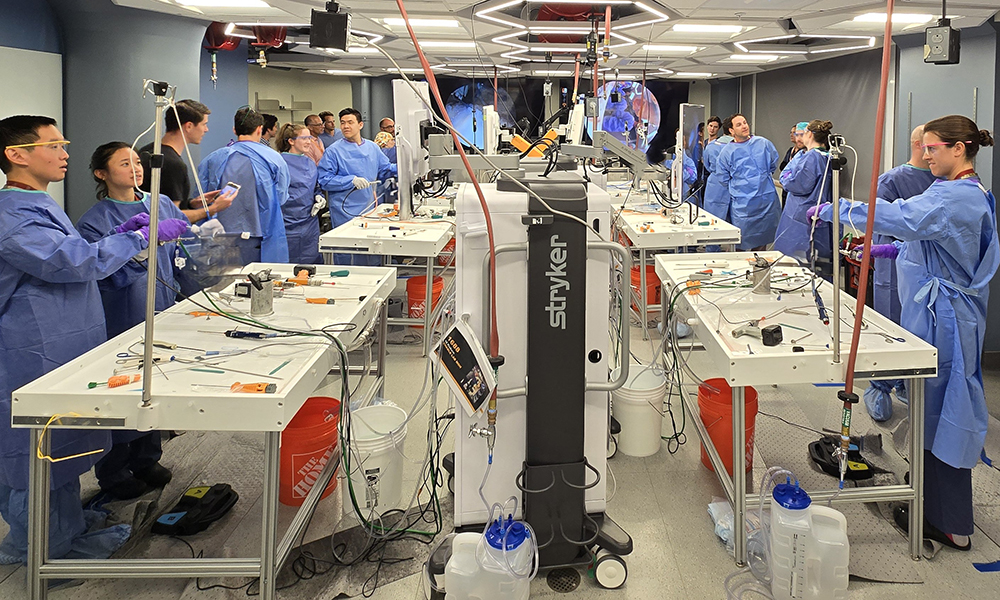
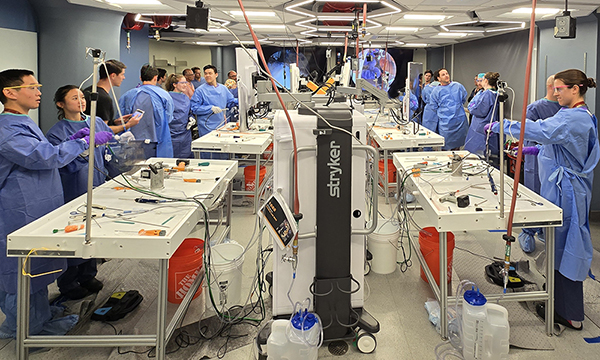
Mass General Brigham Enable Educational and Research Facility
Charlestown Navy Yard
149 13th Street, 4th Floor
Charlestown,
MA
02129
Overview
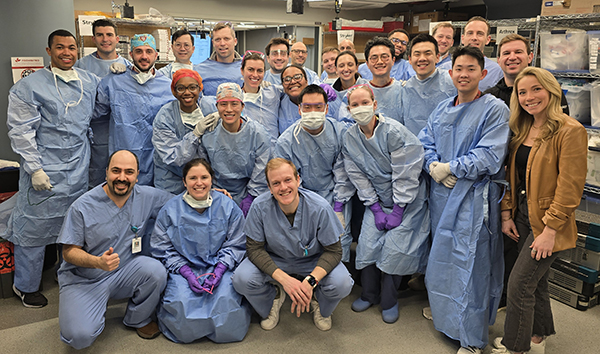
The Mass General Brigham Enable Facility is dedicated to advancing orthopedic care through a unique integration of education, research, and innovation. We serve as the homebase for the Harvard Combined Orthopaedic Residency Program (HCORP) trainees, welcoming orthopaedic residents and fellows from Massachusetts General Hospital, Brigham and Women’s Hospital, Boston Children’s Hospital, Beth Israel Deaconess Medical Center, Spaulding Rehabilitation Hospital and all Harvard-affiliated institutions.
Our mission is simple: Enable surgeons to improve patient outcomes.
The Enable Facility is designed to support every stage of orthopaedic education and research. From hands-on bioskills training to translational cell biology and computational biomechanics, our integrated approach ensures that discoveries in the lab translate directly to improved patient outcomes.
Bioskills Training
Our Bioskills laboratories provide immersive, hands-on training opportunities across all orthopaedic specialties. Regularly scheduled labs cover a wide range of areas including:
- Shoulder, elbow, hip, knee, spine, and hand/wrist procedures
- Arthroplasty, trauma, and sports medicine workshops
- Advanced techniques with robotic-assisted systems and novel implants
These sessions ensure that residents, fellows and practicing surgeons refine their skills in a controlled, supportive environment.
Advanced Capabilities & Equipment:
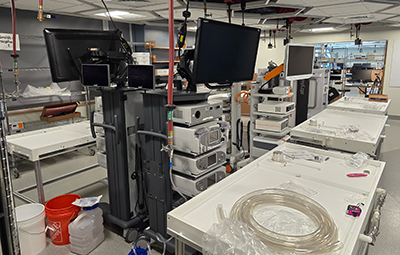
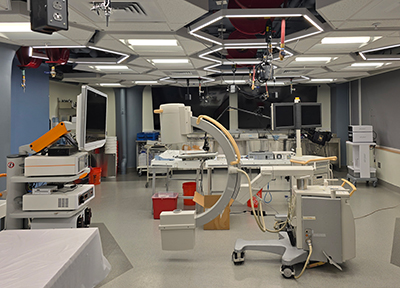
The Enable Facility is equipped with cutting-edge technology to support both experimental and training initiatives, including:
- Instron Mechanical Testing System for load-to-failure and material testing
- Vicon Motion Analysis Cameras for 3D kinematic and high-speed movement analysis
- Tekscan Pressure Transducers for quantifying joint loading and contact pressures
- C-Arm Fluoroscopy System for real-time intraoperative imaging
- Virtual Reality Surgical Simulation with PrecisionOS Orthopaedic Software
- Multiple Arthroscopy Towers (2 Arthrex, 2 Smith & Nephew, 2 Stryker) for training and procedural innovation
This state-of-the-art infrastructure enables both high-fidelity biomechanical testing and immersive Bioskills training for residents, fellows, and practicing surgeons.
Biomechanics Research
Biomechanics fuels the Enable Facility’s innovation mission. Using cadaveric testing, motion analysis, finite element modeling, and implant evaluation, our team addresses critical challenges in musculoskeletal surgery.
Highlighted projects include:
- Patellar Tendon Repair Optimization: Comparative biomechanics of FiberTak anchors with and without internal brace vs. trans-osseous techniques using high-cycle loading and motion capture analysis.
- Finite Element Analysis of Glenoid Anchor Placement: Identifying anchor angle and size that may predict “postage stamp fractures.”
- Remplissage Anchor Placement in Hill-Sachs Lesions: Studying the balance between stability and preserving range of motion.
- Coracoid Anatomy and Biomechanics: Evaluating length, osteotomy, and repair strategies to guide surgical techniques.
Through biomechanics, the Enable Facility builds the engineering foundations that inform safer and more effective orthopaedic surgeries.
Clinical Outcomes Research
The Enable Facility bridges lab research and patient care through large-scale clinical outcomes studies. Using prospective data registries and retrospective analyses, we investigate the effectiveness of surgical innovations. Examples include:
- PatientIQ – An automated digital platform to collect, track, and report patient-reported outcomes across surgical and non-surgical orthopaedic cases.
- Parsonage-Turner Syndrome (PTS): Retrospective review of >250 patients, leading to one of the largest datasets in this rare neuromuscular disorder.
- Rotator Cuff Repair with Bursa Reimplantation: Comparing bursa reimplantation alone vs. reimplantation combined with PRP and thrombin.
These projects ensure that discoveries in the Enable Facility lead directly to measurable patient benefits across MGH and the broader Mass General Brigham network.
Cell Biology Research
The cell biology program focuses on regeneration and biologic therapies for musculoskeletal healing. Projects examine the cellular and molecular processes that drive tissue repair and response to biologics. Key initiatives include:
- ACL Cell Ligamentization Studies: Proliferation, viability, and ligamentization under enhanced PRP conditions.
- Cell Viability Studies: Effects of time on tendon, bursa, capsule, cartilage, bone, and muscle cells.
- Biologic Patches: Evaluation of autologous platelet-rich bursa patches, novel Rotium biologic scaffolds, and patch durability under mechanical stress.
- Lazer and musculoskeletal research– Effects of high-powered lasers on inflammation and cytokine expression with bursa and tenocytes derived from human cells.
- Tendon Cell Characterization – Growth and differentiation patterns of tendon cells at distinct humeral head locations (e.g., greater tuberosity).
These studies build the foundation for next-generation biology that enhances healing and improves long-term outcomes.
Our Commitment
The Enable Facility unites bioskills, biomechanics, cell biology, and clinical outcomes research under one roof. Our interdisciplinary team is driven by curiosity, innovation, and a commitment to improving patient lives.
We are building the future of orthopaedics by combining the best of education, engineering, and biology—ensuring that surgeons are equipped not only with technical skills, but also with scientifically validated methods that elevate patient care worldwide.
Our Team
- Alireza Gholipour, PhD (Biomechanics and Bioskills)
- Marco Di Stefano, MD (Bioskills and Biomechanics)
- Stefan Lev Minyayluk, BS (Cell Biology)
- Mary Beth McCarthy, BS (Cell Biology)
- Mark Cote, DPT (Clinical outcome)
- Michael Giacinto Young, BS (Clinical outcome)
- Sarah Coffey, BS, MS (Research Manager)
- Emily Berner, BS (Research Manager)
Research Positions/Current Opportunities
MD and PhD Postdoc positions are available – non-funded.
For more information about research positions, please contact:
- Augustus "Gus" Mazzocca, MD (amazzocca@mgh.harvard.edu)
- Alireza Gholipour, PhD (agholipour@mgh.harvard.edu)
Mass General Brigham Enable Educational and Research Facility
The Enable Educational and Research Facility at Mass General Brigham is dedicated to empowering surgeons to achieve successful outcomes for their patients.