
Krantz Family Center for Cancer Research
Rheinbay Lab

Explore the Rheinbay Lab
2024 Krantz Awards Recipient
2024 Breakthrough Award: Targeting intrinsically disordered protein domains in cancer
Team: Esther Rheinbay, PhD and Miguel N. Rivera, MD.
Learn about the team's project and the Krantz Awards
Research Summary
Most known genomic drivers of cancer are in coding genes, affecting the encoded protein’s interaction with other proteins, DNA or biological compounds. Recent advances in DNA sequencing technology have made it possible to study non-coding regions that regulate these protein-coding genes. Several cancer drivers have been identified and characterized in these regulatory regions, however, this genomic territory remains relatively unexplored in human tumors. The Rheinbay laboratory concentrates on identifying and functionally characterizing these non-coding drivers in the sequences of tumor whole genomes through development of novel analysis strategies and collaborations with experimental investigators.
We are also interested in the contribution of the sex chromosomes, especially the Y chromosome, to cancer. Loss of Y is known to be associated with morbidity and mortality in aging men, yet its role in tumors is largely unclear. Much of this is due to technical challenges that our group aims to solve. Understanding the driver genes on the sex chromosomes will help us explain differences in male and female tumors, and forge a path to more effective, sex-informed treatment.
Research Projects
Regulatory driver mutations in cancer genomes
Genomic cancer driver discovery has traditionally focused on protein-coding genes (the human exome), and large-scale sequencing of these genes in thousands of tumors has led to the discovery of novel frequently altered genes. However, exome sequencing focused only on coding genes does not allow analysis of non-coding regions in the human genome. Proteincoding genes are regulated by several types of genomic elements that control their expression (promoters, distal enhancers and boundary elements), translation (5’UTRs) and mRNA stability (3’UTRs). Alterations in the DNA sequence of these elements thus directly affect the expression and regulation of the target gene. Several such non-coding elements have been identified as recurrently altered in human cancer, and functionally characterized, although these non-coding drivers appear infrequent compared to protein-coding oncogenes and tumor suppressors. One reason might be that gene regulation is highly tissue-specific, and therefore driver alterations in non-coding regions might create a fitness advantage in only a single tumor type. Finding such a specific driver requires a sufficient number of whole genomes from this tumor type. With recent advances in DNA sequencing technology and an increasing number of whole cancer genomes available for analysis, we are just starting to map out and characterize regulatory driver alterations. The Rheinbay laboratory works on the development of novel methods to identify non-coding driver candidates using genomic and epigenomic sources of information, and to understand their impact on tumor initiation, progression and treatment resistance through collaborations with experimental colleagues.
Role of the sex chromosomes in cancer
Cancer affects men and women disparately, with strong differences in incidence and outcome in some tumor types. Human sex is determined by the sex chromosomes X and Y. Because men only have one X chromosome, they are particularly vulnerable to congenital and acquired somatic variants in X-linked genes. It has been shown that both sex chromosomes can be lost in both normal blood cells with age, as well as certain tumor cells. Yet the meaning of Y chromosome loss, and possible cancer genes on this chromosome, are poorly understood. This is because Y is technically challenging to study with commonly used ‘omics’ profiling approaches. We develop analysis strategies and methods to tackle these technical challenges and use them to find new X and Y-linked drivers in published tumor genome sequences. Our goal is to identify sex-specific, and potentially targetable, vulnerabilities in human cancer.
Publications
Selected Publications
Qi M, Pang J, Mitsiades I, Lane AA, Rheinbay E. Loss of chromosome Y in primary tumors. Cell, 2023; 186(14): 3125-3136.
Qi M, Nayar U, Ludwig, LS, Wagle N, Rheinbay E. cDNA-detector: detection and removal of cDNA contamination in DNA sequencing libraries. BMC Bioinformatics. 2021. 22:611
Rheinbay, E.*, Nielsen, M.M.*, Abascal, F.* et al. Analyses of non-coding somatic drivers in 2,658 cancer whole genomes. Nature 578, 102–111 (2020).
Rheinbay E, Parasuraman P, Grimsby J, et al. Recurrent and functional regulatory mutations in breast cancer. Nature. 2017;547:55-60.
Suva ML*, Rheinbay E*, Gillespie SM, et al. Reconstructing and reprogramming the tumor-propagating potential of glioblastoma stem-like cells. Cell. 2014;157:580-94.
*Equal contribution
We're Hiring! Postdoctoral Position
Postdoctoral Position in the Rheinbay Laboratory
Open position in computational cancer genomics to study cancer drivers and gender differences in cancer.
We are looking for a self-motivated postdoctoral researcher with a strong background in computational science and experience with large data sets. The successful candidate will join an interdisciplinary team working on rigorous analysis of next generation sequencing data (DNA, RNA, chromatin) from tumor samples, and development of analysis tools that will be shared with the research community. This is a unique training opportunity with access to resources at the Mass General Brigham Cancer Institute, Harvard Medical School and the Broad Institute.
Qualifications:
- PhD in computational biology, bioinformatics, computer science, physics or applied math
- Strong publication record, communication and writing skills, fluency in English
- Excellent programming skills in Python and R, experience with cloud computing environments preferred
- Ability to work together with multi-disciplinary teams consisting of physicians, experimental scientists, statisticians and software engineers
- Experience with NGS data processing and analysis is desired
Interested candidates should submit a cover letter, curriculum vitae, research background and interests and contact information for three references to: Dr. Esther Rheinbay, erheinbay@mgh.harvard.edu.
Research Image
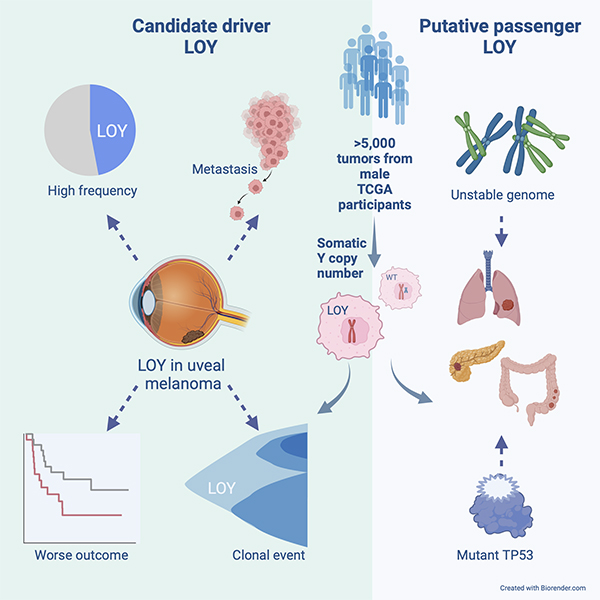
Y chromosome loss in cancer can be a driver (left) or passenger (right) event.
Our Researchers
Esther Rheinbay, PhD
Group Members
- Luis Antonio Corchete Sánchez, PhD*
- Preshita Dave**
- Philipp Hähnel, PhD***
- Ema Klefti
- Garrett Lam†
- Andrey Leshchiner
- Xavi Loinaz††
- Irene Rin Mitsiades
- Andres Fillizzola Ortiz
- Gengchao Wang, PhD
* Co-mentored with Langenau lab
** Co-mentored with Lawrence lab
*** Co-mentored with Brastianos Lab
† Co-mentored with Ellisen Lab
††Co-mentored with Getz Lab