The Bone Marrow Transplant (BMT) Survivorship Program aims to improve the experience
and outcomes of BMT survivors and families through focused clinical care and research.
To make an appointment, please contact: Kerri Tortora Tel: 617-726-5765 ktortora1@partners.org
How to Help
Your donation to the BMT Survivorship Fund supports the program's mission to reduce suffering for survivors of bone marrow transplantation by providing outstanding clinical care and conducting research that aims to improve the delivery, experience and outcomes of survivorship care. Make a gift.
Explore BMT Survivorship
Overview
Due to advances in bone marrow transplant practices, more individuals are living longer free of their cancer diagnosis than ever before. In this environment, the cancer experience is shifting from an acute illness to a chronic condition. We are beginning to recognize the full range of medical, functional, and psychological challenges facing bone marrow transplant (BMT) survivors. Consequently, survivorship has become a distinct phase of cancer care that requires more focused attention. Survivorship refers to the process of living with, through, and beyond cancer. Survivorship is unique for every person. Everyone has to find his or her own path to navigate the changes and challenges that occur as a result of living with cancer.
Our Mission
The goal of this program is to improve the experience and outcomes of bone marrow transplant (BMT) survivors and their families by:
Providing high-quality clinical survivorship care
Conducting innovative research to enhance the delivery, experience, and quality of life and care for BMT survivors, their families, and caregivers
Multidisciplinary Clinical Care
Survivors will be able to regularly see BMT specialists who also have expertise in other medical areas, creating a one-stop treatment plan that reduces secondary and potentially stressful doctor visits elsewhere.
Our clinical program is designed to comprehensively explore the needs of BMT survivors and their families and improve their quality of life and overall care, including:
Physical symptoms with emphasis on pain and fatigue
Psychological distress: anxiety, depression, fear of disease recurrence
Chronic graft-versus-host disease involving any organ
Physical activity and functional limitations
Cognitive dysfunction
Hormonal deficiencies
Bone health
Sleep disturbances
Sexual dysfunction and fertility concerns
Late effects of cancer therapy including cardiopulmonary dysfunction
Cancer prevention
Immunizations and infections
Research
The Mass General Bone Marrow Transplant Survivorship Research Program focuses on enhancing the quality of life and care for BMT survivors and their families in the following areas:
Symptom Assessment & Intervention
Cancer Prevention & Screening
Communication & Treatment Decision-making
Education & Training
Patient Health Behavior and Self-Care
Models of Care & Health Services
The Mass General Brigham Cancer Institute Bone Marrow Transplant Survivorship Program is leading the efforts to develop innovative interventions to address the needs of BMT Survivors. Current ongoing research efforts:
A longitudinal study to assess chronic graft-versus-host disease symptom burden, coping, and their relationship with quality of life and distress in BMT survivors.
Developing a cognitive behavioral therapy intervention to reduce depression and anxiety and improve quality of life for patients living with chronic graft-versus-host disease.
Testing the efficacy of a web-bases BMT survivorship course on enhancing the experience and overall QOL of BMT survivors.
Qualitative research efforts to comprehensively understand the challenges facing bone marrow transplant survivors and their family caregivers.
Developing and testing a multi-component intervention to enhance the quality of life and reduce distress in family caregivers of BMT survivors.
A multimodal intervention to address sexual dysfunction post-transplant: a feasibility and preliminary efficacy study.
BMT Survivorship Program database: collecting comprehensive patient-reported outcomes on BMT survivors with a detailed needs assessments to allow for future development of targeted interventions to improve the care of BMT survivors.
Team
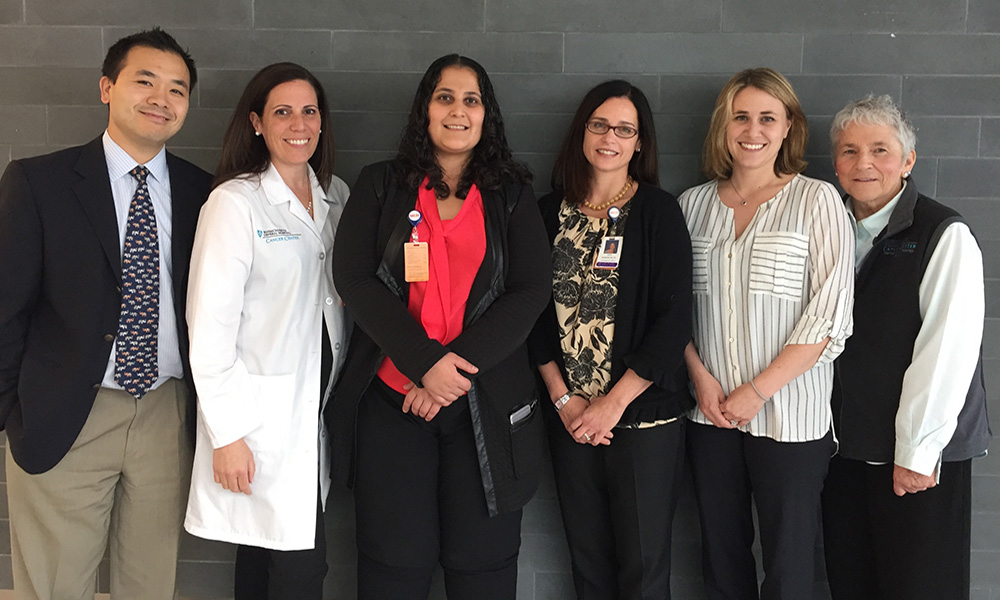
Meet the BMT Survivorship Core Team and Consulting Providers.
Director, Hematopoietic Cell Transplant & Cell Therapy Program
Allen B. Rogers, Jr. and Cara J. Rogers Endowed Chair
Professor of Medicine, Harvard Medical School
Patient Education & Resources
As you have completed your initial cancer treatment and BMT, you might be wondering: what happens next? Understanding and recognizing the challenges that face BMT survivors can help you through this time of transition. Understanding and recognizing these challenges are the first steps in developing strategies to adapt to the changes affecting your life after BMT.
Learn about the resources the Cancer Institute offers to assist you & your family.
News
BMT Survivorship program featured in The Oncology Nurse-APN/PA
The Oncology Nurse-APN/PA spoke with Julie Vanderklish, NP, about the comprehensive efforts involved in planning the BMT Survivorship program and bringing it to fruition. (Used with permission from The Oncology Nurse-APN/PA, Vol. 10, No. 2, March 2017.)
Through community fundraising, a non-Hodgkin’s lymphoma survivor raised more than $138,000 to help create MGH’s Bone Marrow Transplant Cancer Center Survivorship Program.
A new study by investigators from Mass General Brigham showed that a new app they created can help improve the quality of life for caregivers of patients undergoing bone marrow transplant.
Bone Marrow Transplant Survivorship Program
The Bone Marrow Transplant (BMT) Survivorship Program aims to improve the experience and outcomes of BMT survivors and families through focused clinical care and research.